South African Newspaper Mail & Guardian Published Chinese Premier Li Keqiang's Speech at 2013 Summer Davos and State Councilor Yang Jiechi's Article on China's Diplomatic Theory and Practice
On October 4, 2013, Mail & Guardian, one of
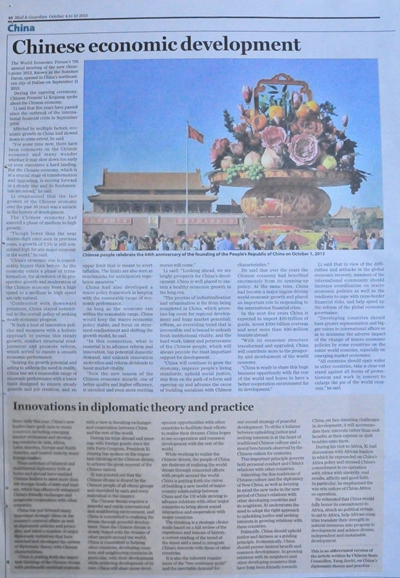
Chinese economic development
The World Economic Forum's 7th annual meeting of the new champions 2013, known as the Summer Davos, opened in
During the opening ceremony, Chinese Premier Li Keqiang spoke about the Chinese economy.
Li said that five years have passed since the outbreak of the international financial crisis in September 2008.
Affected by multiple factors, economic growth in
"For some time now, there have been many comments on the Chinese economy and many wonder whether it may slow down too early or even encounter a hard landing. But the Chinese economy, which is at a crucial stage of transformation and upgrading, is moving forward in a steady way and its fundamentals are sound," he said.
Li emphasized that thefast growth of the Chinese economy over the past 30 years was a miracle in the history of development.
The Chinese economy had entered a phase of medium to high growth.
"Though lower than the near double-digit rates seen in previous years, a growth of 7.5 percent is still considered high for any major economy in the world," he said.
"
"Confronted with downward pressures,
"It took a host of innovative policies and measures with a holistic approach to pursue this steady growth, conduct structural readjustment and promote reform, which served to ensure a smooth economic performance.
"Seizing the growth potential and acting to address the need in reality,
As long as the economy ran within the reasonable range,
"In this connection, what is essential is to advance reform and innovation, tap potential domestic demand, and unleash innovation motivation and reform dividends to boost market vitality
"Now the new season of the Chinese economic miracle, one of better quality and higher efficiency, is unveiled and even more exciting stories will come."
Li said:"Looking ahead, we see bright prospects for China's development.
"The process of industrialization and urbanization is far from being completed in China, which promises a big room for regional development and huge market potential; reform, an overriding trend that is irreversible and is bound to unleash fresh institutional vitality; and the hard work, talent and perseverance of the Chinese people, which will always provide the most important support for development.
"
He said that over the years the Chinese economy had benefited enormously from its opening-up policy. At the same time,
In the next five years,
"With its economic structure transformed and upgraded,
"
Li said that in view of the difficulties and setbacks in the global economic recovery, members of the international community should increase coordination on macro economic policies as well as the readiness to cope with the cross-border financial risks, and help speed up the reform of the global economic governance.
"Developing countries should have greater representation and bigger voices in international affairs so as to minimize the adverse impact of the change of macro economic policies by some countries on the entire world economy, especially on emerging market economies.
"All countries should open wider to other countries, take a clear-cut stand against all forms of protectionism and work in concert to enlarge the pie of the world economy," he said.
Innovations in diplomatic theory and practice
Recently, the Chinese State Councilor Yang Jiechi wrote an article on
Since early this year,
These activities of bilateral and multilateral diplomacy both at home and abroad have enabled Chinese leaders to meet more than 100 foreign heads of state and leaders, which has effectively enhanced
C
During his trips abroad and meetings with foreign guests since the 18th Party Congress, President Xi Jinping has spoken on the important thinking of the Chinese dream, to achieve the great renewal of the Chinese nation.
Xi has pointed out the Chinese dream is shared by the Chinese people of all ethnic groups and cherished by each and every individual in the country.
The Chinese dream requires a peaceful and stable international and neighboring environment, and
While working to realize the Chinese dream, the people of
The thinking is a strategic choice made based on a full review of the experience and lessons of history, a correct reading of the trend of the times and a need to integrate
It is also the inherent requirement of the "two centenary goals" and the inevitable demand for our overall strategy of peaceful development. To strike a balance between upholding justice and seeking interests is at the heart of traditional Chinese culture and a moral benchmark observed by the Chinese nation for centuries.
This important principle governs both personal conduct and
Inheriting the fine traditions of Chinese culture and the diplomacy of New China, as well as keeping in mind the new tasks in the new period of
Politically,
During his visit to Africa, Xi had discussions with African leaders, in which he expounded on
He reiterated that
**********************************************************************************************************************************************************************
On the same day, Mail & Guardian also published two reports on
the Ambassadorial Forum on China - South Africa Diplomatic Relations at 15 Years.Embassy of the People's Republic of China in the Republic of South Africa
Address: 225 ATHLONE STREET,ARCADIA0083,PRETORIA,SOUTH AFRICA
Mailbox:P.O.Box 95764,Waterkloof 0145, Pretoria,South Africa
E-mail:chinaemb_southafrica@mfa.gov.cn
Consular and Policing Section
24-hour Consular Protection Hotline: 0027-104925583 (Calls during 12:00-13:30 & 17:30-08:00 GMT+2
on weekdays or during weekends and holidays will be transferred to
MFA's Global Consular Protection and Services Emergency Hotline 12308)
For queries, call: 0027-12-4316537 (answering time 8:00-12:00 on weekdays) Or send an e-mail to: pretoria@csm.mfa.gov.cn

The Embassy of the People's Republic of China in the Republic of South Africa holds all rights to this content.
Use of any kind without written permission is not allowed.